Can You Take a Dog from the UK to Europe Without a Car?
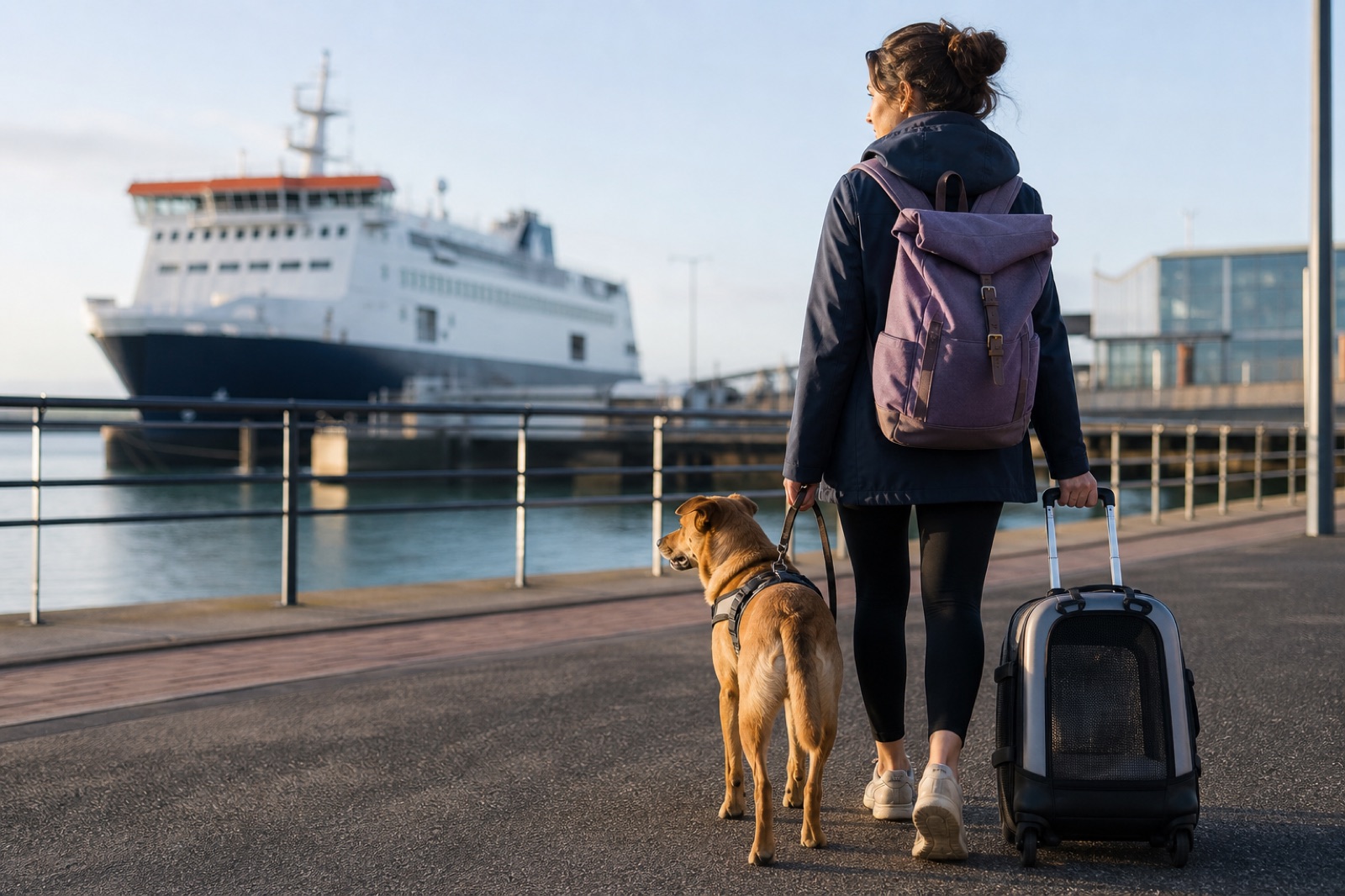
Yes, but route rules vary. Compare foot-passenger ferries, pet taxis and rail connections for taking a dog between the UK and Europe without a car.
Yes, you can take a dog between Great Britain and continental Europe without owning a car—but you cannot assume that every ferry, train or approved pet route accepts ordinary pets from foot passengers.
The most practical options include selected ferries that accept foot passengers with pets, a booked pet taxi or minibus through LeShuttle, and a train-and-ferry itinerary via ports such as Newhaven–Dieppe or Harwich–Hook of Holland.
Your best route depends on where you start, where you are going, whether the operator accepts your type and number of pets, and whether the animal must use a kennel, carrier or pet-friendly cabin. Check the operator before buying separate rail tickets or accommodation.
This guide covers ordinary pet dogs. Recognised assistance animals can have different access arrangements.
Why travelling without a car is confusing
Three questions are often mixed together:
- Is the route approved for pets entering Great Britain?
- Does the company carry pets on that sailing or service?
- Does it accept an ordinary pet from a passenger travelling without a vehicle?
A “yes” to the first question does not automatically mean “yes” to the third.
GOV.UK says pets entering Great Britain must use certain approved routes and companies, and that those routes can change or operate seasonally. It also tells owners to ask the travel company whether it accepts their pet, how many pets it accepts and whether it needs additional evidence.
Start with the current GOV.UK list of approved sea and rail routes, then check the operator’s foot-passenger rules for the exact sailing.
Can you take a dog on Eurostar?
Eurostar publishes arrangements for recognised guide and assistance dogs and assistance cats travelling to or from London. It does not offer the same process for an ordinary pet dog.
This is why searching only for “train from London to Paris with a dog” can lead to a dead end. A rail-based itinerary normally needs another way to cross the Channel, followed by ordinary domestic or European trains where the relevant train company’s pet rules allow it.
Do not confuse Eurostar with LeShuttle. Eurostar is the passenger train from city centre to city centre. LeShuttle carries road vehicles through the Channel Tunnel. A traveller without a car can use LeShuttle only through a suitable vehicle-based service, such as a pet taxi or minibus that accepts both the passenger and dog.
Option 1: Newhaven to Dieppe as a foot passenger
DFDS currently advertises Newhaven–Dieppe as a route where foot passengers can travel with dogs. Its route information says onboard kennels are available and that pet cabins are also offered, subject to availability and booking conditions.
This option can work well for a London-to-France rail itinerary:
- travel by train to Newhaven
- reach the ferry terminal with enough time for pet check-in
- cross to Dieppe using the accommodation booked for the dog
- continue from Dieppe by local transport and rail
DFDS states that Dieppe railway station is about 2 kilometres from the terminal and describes the walk as roughly 28 minutes. That is useful context, but consider luggage, weather, pavements and your dog’s mobility before planning a tight connection.
Confirm these points directly with DFDS before booking:
- whether your sailing accepts a foot passenger with your dog
- kennel or pet-cabin availability
- dog-size or accommodation restrictions
- check-in time and terminal transfer arrangements
- whether cats or other pets are accepted from foot passengers
- what bedding, water, food or carrier you must bring
The operator’s current Newhaven–Dieppe route page is the primary source for its service.
Option 2: Harwich to Hook of Holland
Stena Line says foot passengers on the Harwich–Hook of Holland route can travel with up to three pets, but they must book an onboard kennel or pet-friendly cabin.
This can be a useful route when the Netherlands, Germany or northern Europe fits the journey better than northern France. Harwich International has a rail connection on the British side, and the Hook of Holland connects into the Dutch public-transport network.
An overnight crossing may also suit owners who prefer a longer sailing with booked cabin accommodation. It is not automatically the best choice for every dog: journey length, kennel or cabin availability and onward connections still matter.
Read Stena Line’s current Harwich–Hook of Holland pet rules before booking.
Option 3: a pet taxi or shared minibus through LeShuttle
A pet taxi or scheduled pet minibus can collect passengers on one side of the Channel, carry them through LeShuttle in a vehicle and connect them with a station or address on the other side.
This can reduce the complexity of coordinating a ferry and port transfers, particularly for Calais, Folkestone, London or Paris connections. It can also cost considerably more than a foot-passenger ticket, especially for a private vehicle.
Before paying a transport provider, ask:
- whether you travel in the same vehicle as your dog
- whether the price is private or shared
- the exact pickup and drop-off points
- the luggage and pet-carrier allowance
- what happens if a train, ferry or veterinary appointment is delayed
- whether the provider is handling an accompanied pet journey or a separate animal-transport service
- what cancellation and missed-connection terms apply
Do not treat a social-media recommendation as confirmation that a company is operating, insured or available for your dates. Check the provider directly.
What about Dover to Calais?
Dover–Calais is an approved pet route, but that does not mean every operator accepts ordinary pets from foot passengers. Many short-Channel pet arrangements are designed around animals travelling in a vehicle.
If Dover or Calais is important to your itinerary, ask the chosen ferry company the exact question: “Can I book this sailing as a foot passenger with an ordinary pet dog?” Get the answer before booking the trains that connect with it.
Could you travel through the Netherlands instead?
Yes. Recurring traveller discussions mention both Harwich–Hook of Holland and Newcastle–Amsterdam because longer North Sea services can offer kennels or pet-friendly cabins to foot passengers on selected sailings.
GOV.UK’s current approved-route list includes:
- Hook of Holland to Harwich with Stena Line
- Amsterdam (IJmuiden) to Newcastle with DFDS
- Rotterdam (Europort) to Hull with P&O Ferries, specifically noting approval to carry pets travelling with foot passengers
Approval is still not a booking promise. Confirm the operator’s current passenger, pet-accommodation and seasonal rules for both directions.
Your paperwork does not change because you are on foot
Travelling without a car changes the transport puzzle, not the underlying pet-travel requirements.
For a typical journey from England, Scotland or Wales to the EU, your dog normally needs:
- a microchip
- a valid rabies vaccination
- an Animal Health Certificate, unless another accepted document applies
Our Animal Health Certificate guide explains the document and validity periods. If you are unsure who can issue it, read Can normal vets issue Animal Health Certificates?.
For the return to Great Britain, use an approved route and make sure the pet meets the entry rules. Dogs usually need tapeworm treatment given and recorded by a vet between 24 and 120 hours before arrival, unless a direct-travel exemption applies. See our dog tapeworm-treatment timing guide.
Plan the outward and return routes together
Do not confirm only the outward crossing. A service that works from Great Britain to Europe may have different pet-check, timetable or foot-passenger arrangements on the return.
Build the itinerary in this order:
- Choose a possible outward and return crossing.
- Confirm foot-passenger pet acceptance with each operator.
- Check kennel, carrier or pet-cabin requirements.
- Check the current official rules and documents for both directions.
- Allow realistic time for port transfers and pet check-in.
- Locate a vet for any return tapeworm treatment before finalising the schedule.
- Only then book the connecting trains and accommodation.
If France is part of the route, our UK-to-France dog travel guide brings the first EU entry point, AHC and return checks together.
Quick answer
- You can take a dog between the UK and Europe without owning a car.
- Ordinary pets generally cannot use the London–continental Eurostar process available to recognised assistance animals.
- Selected ferries accept foot passengers with dogs, but accommodation and route rules vary.
- Newhaven–Dieppe and Harwich–Hook of Holland are two routes worth checking.
- A pet taxi or minibus can carry you through LeShuttle without your own vehicle.
- An approved route is not proof that a particular sailing accepts pets from foot passengers.
- Check both directions before booking connecting travel.
Use the free UK-to-Europe pet travel checklist to organise the microchip, rabies, AHC and return requirements alongside your transport plan.